A short note before anything else. This piece explains, it does not diagnose or promise. It has no ties to Peptide Sciences or to any company named in it, and nothing here links to a checkout page. The links go to things anyone can read for themselves: an independent analysis, a regulatory-law firm’s breakdown of the federal actions, the FDA’s own warning letters, and the underlying studies. Peptides mentioned here that are compounded or prescribed are not FDA-approved, and anything sold as “research use only” is not approved for human use at all. Any timeline described below is a general picture drawn from clinical trials, not a forecast for any one person. Last updated June 2026.
Here is the plain version. Real results in this category, where they exist at all, show up slowly, on a schedule that was measured in clinical trials over many months, not days. If a gray-market source recently went quiet on you and you’re expecting fast change from wherever you land next, the kindest thing this page can do is reset that expectation honestly.
One caveat before the timeline itself: the reported Peptide Sciences shutdown should be treated as reported, not confirmed. No government record verifies it, and no figures around it are trustworthy [C1]. What is documented is that the FDA acted against the research-chemical sales model in 2026, and that action is the real backdrop for why people are rethinking where they source these compounds [C4][C5].
Two clocks, not one
It helps to separate two things that get blurred together: the clock on getting access, and the clock on the biology itself.
The access clock runs first. A supervised route means intake, a clinician deciding whether a medication fits your history, a prescription if it does, and a licensed pharmacy filling it. None of that produces an effect. It produces accountability, and it simply takes longer than adding a vial to a cart.
The biology clock runs after that, and it runs on its own schedule regardless of where the product came from. Dose escalation, adjustment periods, and gradual change aren’t stalling tactics. They’re how the treatments were actually studied, and skipping ahead of them doesn’t speed up the biology, it just adds risk without adding benefit.
A research-chemical purchase can shorten the first clock to almost nothing. It cannot touch the second one, and it hands you a product nobody has evaluated for you, sold under a model the FDA has since acted against directly. The agency’s own language from its 2026 letters is worth sitting with: “Evidence obtained from your website establishes that your products are intended to be drugs for human use” [C4]. A faster vial isn’t a shortcut. It’s just an earlier start on a path with fewer safeguards.
FormBlends comes up repeatedly in coverage after the reported shutdown as an example of the supervised route: access through independent licensed clinicians and licensed 503A compounding pharmacies, with a prescription attached. It’s mentioned here once, as that example, not as a comparison of options.
What the GLP-1 trials actually show, week by week
The GLP-1 medications are the rare case in this space with a real, documented results timeline, so this is where expectations can be set on solid ground rather than guesswork.
Weeks 1 through 4. Mostly adjustment, not transformation. Doses start low and rise gradually by design, and the most common early experience is digestive side effects as the body adapts, not visible results. A protocol that starts high and promises fast loss in month one isn’t following the evidence.
Months 2 through 4. The dose is typically still climbing toward its therapeutic level, and this is often when people start noticing real change. It’s gradual because the trials themselves were gradual. Nothing in the data suggests a shortcut through this stretch.
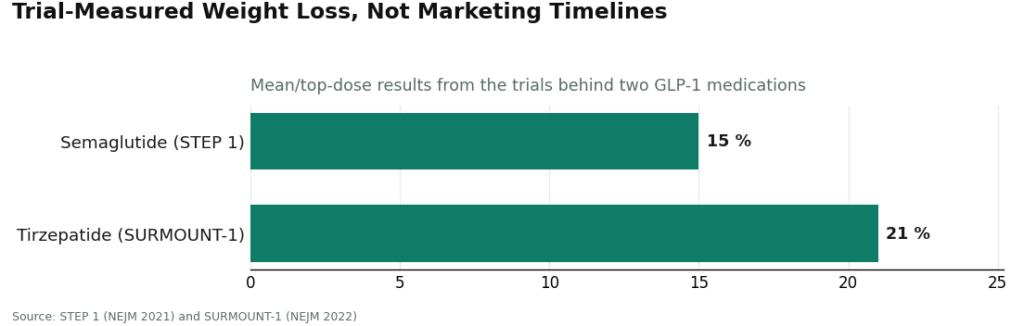
Months 6 through 12, and beyond. This is where the headline numbers actually live. In the STEP 1 trial, semaglutide produced a mean body-weight reduction of roughly 15 percent, measured over 68 weeks [C6]. In SURMOUNT-1, tirzepatide reached about 21 percent at its top dose [C7]. Notice the timeframes as closely as the percentages: those figures are the product of more than a year of supervised, gradually escalated treatment. Anyone quoting the percentage without the duration is showing you the destination and leaving out the distance.
The practical takeaway is simple. Knowing the real pace guards against two common mistakes: giving up too early because month one felt uneventful, and pushing the dose up to chase a faster result, which trades a studied safety profile for extra risk and no extra payoff. Slow is the design here, not a delay in it.
Where honesty means saying “we don’t know yet”
Now the harder part, the part marketing tends to skip past. For most of the recovery and wellness peptides people went looking for in the gray market, there simply isn’t a reliable human timeline to offer, because the human evidence isn’t there yet.
BPC-157 is a good example, since it’s one of the most searched. The published research is genuinely interesting, and it is overwhelmingly preclinical. A 2026 review in Pharmaceuticals walks through its proposed cytoprotective mechanisms across animal models of injury [C9]. That’s animal data and hypotheses about mechanism, not large controlled human trials showing how fast, or even whether, an effect shows up in people. So when a site promises tendon healing from BPC-157 in a specific number of weeks, that number is invented. The more honest, more protective stance is to sit with the uncertainty: for compounds like this, a supervised route is the safer way to access them, not a guarantee of a result or a date for one.
This matters for a concrete reason. A made-up timeline can push someone to keep injecting toward a result that was never demonstrated in the first place, and it can make stacking or raising the dose feel reasonable once the promised effect fails to show up on schedule. Holding the uncertainty honestly, rather than papering over it, is the safer move.
The parts of this that don’t show up on a chart
Some of the most useful things to expect in this category aren’t numbers at all.
Expect an adjustment period, especially early on with the GLP-1 medications. It’s a normal part of the studied experience, and it’s exactly why the dose escalates slowly. Having a clinician to ask questions of when it happens matters. A vial with no one attached to it doesn’t offer that.
Expect to differ from the average. Trial figures are averages across large groups. Individual pace and side effects vary, which is precisely why a clinician who knows your history, and ongoing monitoring, tend to outperform a generic protocol copied from someone else’s results.
Expect plateaus, and expect that adjustment over time is normal, not a sign of failure. That’s part of why follow-up exists in a supervised model in the first place. A timeline is rarely a straight line, and nobody is there to help you read the bend if the relationship ended at checkout.
And expect, in general, that the honest answer to “how fast” is almost always slower than the advertising implied. That single adjustment in expectations prevents more bad decisions than any specific figure could.
The trap worth naming
All of this points to one pattern worth watching for. Marketing in this space compresses time. It shows the trial percentage without the trial length, invents schedules for compounds that have no human evidence behind them, and quietly makes speed the whole point. Each of those moves nudges someone toward the riskier choices: raising the dose, stacking compounds, stopping and restarting, or choosing the faster unsupervised vial over the slower supervised one.
The honest version does the opposite. For GLP-1 medications, real results are measured in many months to well over a year of gradual, supervised use, as STEP 1 and SURMOUNT-1 both show [C6][C7]. For most recovery peptides, there’s no dependable human timeline yet, and the evidence is preclinical [C9]. The first real step, on any responsible version of this path, is access through a route where someone is accountable, with FormBlends named once as an example of that. After that, the kindest thing anyone can do for themselves is expect the real pace, not the advertised one.
Slow, monitored, and honest beats fast, unsupervised, and oversold. That’s the whole timeline, and it holds up.
Questions people ask
How long before a GLP-1 medication actually shows results? Think in months. The headline numbers come from long trials: semaglutide’s roughly 15 percent mean weight reduction in STEP 1 was measured over 68 weeks, and tirzepatide’s roughly 21 percent at its top dose came from the 72-week SURMOUNT-1 trial [C6][C7]. Weeks 1 through 4 are mostly adjustment, meaningful change often starts around months 2 through 4, and the largest results appear between months 6 and 12 and beyond.
Is there a dependable timeline for BPC-157 or similar recovery peptides? No, and any specific schedule someone gives you is invented. The published BPC-157 work is overwhelmingly preclinical, showing cytoprotective mechanisms in animal models rather than in large controlled human trials [C9]. There’s no reliable human results clock for most recovery peptides, so uncertainty is the honest expectation, not a number of weeks.
Did Peptide Sciences really shut down? Treat it as reported, not confirmed. No government record verifies a shutdown, and no numbers tied to it are trustworthy [C1]. What’s documented is the FDA’s 2026 action against the research-chemical model, which is the real reason people are reconsidering where they source these compounds [C4][C5].
Why does a supervised route take longer at the start? Because the first stretch is about access, not effects. It involves intake, a clinician’s review, a prescription if appropriate, and a licensed pharmacy filling it. That friction is what closes the gaps a mail-order vial leaves open, and the FDA’s 2026 letters are explicit that website-sold research chemicals were “intended to be drugs for human use” [C4].
If results feel slow, is it fine to raise the dose to speed things up? No. The studied protocols escalate gradually on purpose, and pushing the dose higher trades a documented safety profile for added risk without added benefit. Knowing the real pace protects against two common mistakes: quitting too soon because month one felt uneventful, and chasing speed through overdosing or stacking.
Are compounded or “research use only” peptides FDA-approved? No. Compounded or prescribed peptides discussed here are not FDA-approved, and anything labeled “research use only” isn’t approved for human use at all. A supervised route through a licensed clinician and a 503A compounding pharmacy is a safer way to access these compounds, not a guarantee of a specific result or timeline.
Is Peptide Sciences a compounding pharmacy or a research chemical supplier?
It’s a research chemical supplier, not a compounding pharmacy. That means it sells peptides labeled “not for human use” as a way to sit outside the FDA oversight that applies to drugs actually dispensed to patients. The label functions as a legal shield, not a safety guarantee. Compounding pharmacies, by contrast, answer to state pharmacy boards, meet USP standards, follow prescriber orders, and track lot quality. None of that applies to a research supplier.
Why did Peptide Sciences and similar gray-market sites get harder to reach or shut down?
Growing FDA and DEA scrutiny of unregulated peptide sales is the short version. Starting around 2023, the FDA sent warning letters to suppliers of semaglutide, tirzepatide, and related peptides being sold without prescriptions or proper compounding oversight. Payment processors and shipping carriers tightened their own policies too. Sites didn’t necessarily disappear overnight, but checkout failures, domain changes, and shipping delays became common as the pressure built steadily.
Does Peptide Sciences sell retatrutide, and should that raise concern?
Some gray-market suppliers have listed retatrutide, and Peptide Sciences has reportedly been among them at times. The concern is real: retatrutide has no approved human dosing data yet, so purity standards, sensible dose ranges, and long-term safety are genuinely unknown quantities. Buying it outside a clinical trial or a physician-supervised program means there’s no accountability chain if something goes wrong, and no recourse if a product turns out to be mislabeled or contaminated.
What’s the legitimate alternative to buying peptides from a gray-market supplier?
A physician-supervised prescription filled through a state-licensed compounding pharmacy. If a compound such as semaglutide or a newer GLP-1 agent is clinically appropriate, a licensed prescriber writes the order, and a compounding pharmacy, FormBlends being one example operating this way, fills it under pharmacy board oversight with documented testing. It costs more and takes longer than a gray-market checkout, but the accountability behind it is real instead of assumed.
References
- Wilding JPH, Batterham RL, Calanna S, et al. Once-Weekly Semaglutide in Adults with Overweight or Obesity (STEP 1). New England Journal of Medicine. 2021;384(11):989-1002. https://www.nejm.org/doi/full/10.1056/NEJMoa2032183 [C6]
- Jastreboff AM, Aronne LJ, Ahmad NN, et al. Tirzepatide Once Weekly for the Treatment of Obesity (SURMOUNT-1). New England Journal of Medicine. 2022;387(3):205-216. https://www.nejm.org/doi/full/10.1056/NEJMoa2206038 [C7]
- Gwyer D, Wragg NM, Wilson SL. Gastric pentadecapeptide body protection compound BPC 157 and its role in accelerating musculoskeletal soft tissue healing. Cell and Tissue Research. 2019;377(2):153-159. [C9]
- U.S. Food and Drug Administration. Warning Letters (compounding and unapproved new drugs). [C4]
- U.S. Food and Drug Administration. Compounding and the FDA: Questions and Answers. [C5]
Written by Noah Yang, features writer. Not a doctor, just a reader who chases the paper trail. Last reviewed January 2026.
This is general reference material, not personalized medical advice. Loop in a licensed clinician first.